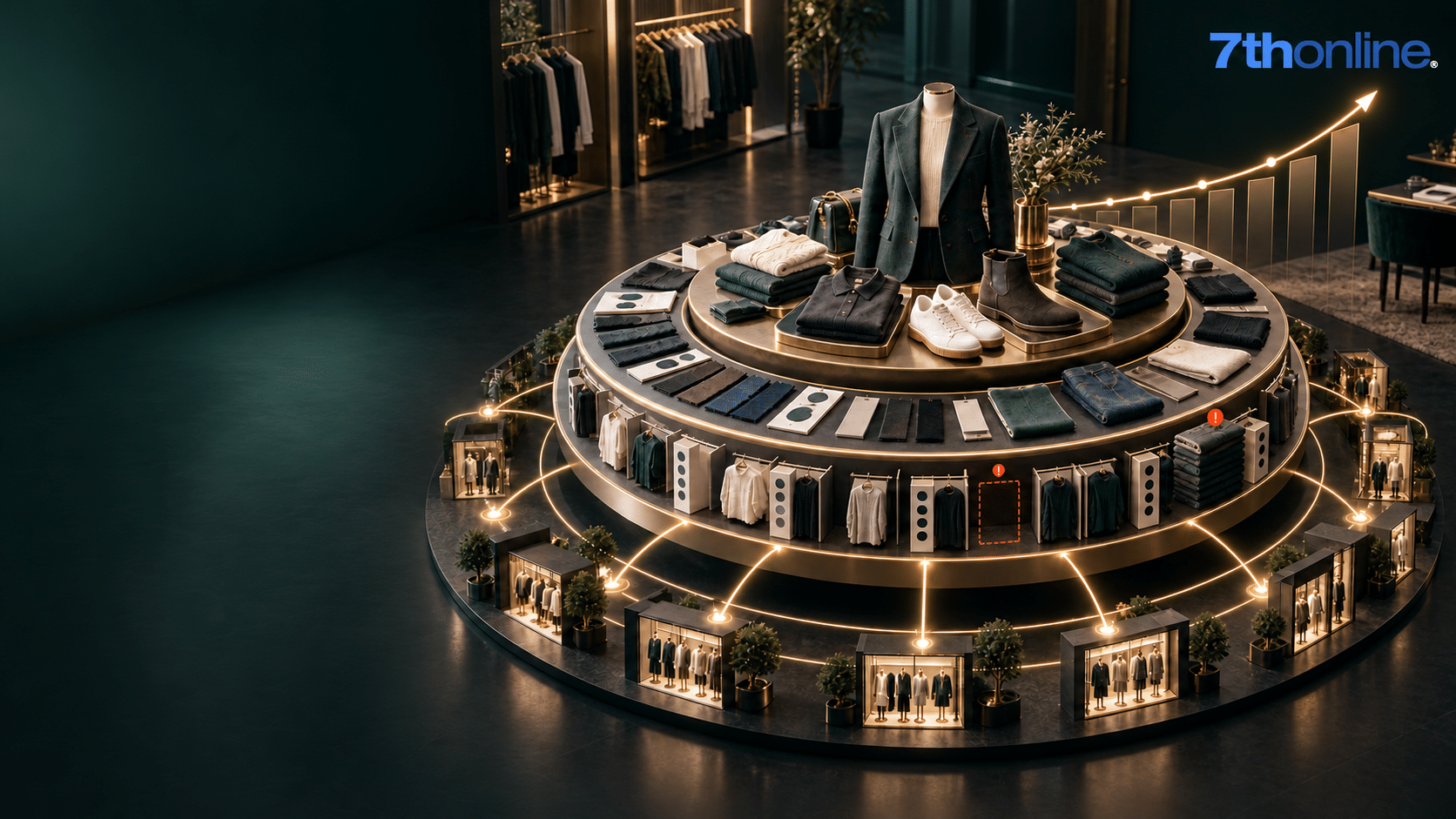
In recent years, a core priority across retail has been accelerating inventory turnover and supply chain agility to mitigate inventory risk, optimize capital utilization, and drive sustainable profit growth. Retailers are starting to recognize that merchandise planning and allocation has to be a data-driven standard operation that unifies production, supply, logistics, inter-store transfers, and point-of-sale (POS) execution into a streamlined end-to-end workflow.
When executed systematically, merchandise planning evolves from a routine workflow into a robust data-driven operational engine that boosts retail brands’ market competitiveness and overall profitability.
Ben Lentini, Chief Product Officer at 7thonline, brings more than 30 years of specialized fashion retail experience. Experience such as retail consulting for Accenture and Director of Merchandising and Group Vice President at Levi’s, has provided Ben valuable industry knowledge. Ben provides deep insight into the technological foundation behind the 7thOnline platform, particularly its breakthroughs in machine learning and artificial intelligence. These advanced technologies deliver unprecedented end-to-end demand visibility, empowering retailers to make highly precise inventory decisions.
According to Ben, what truly sets 7thOnline apart is its deep focus and expertise in retail merchandise planning for the past 26 years. This deep domain expertise enables the platform to effectively resolve seasonal demand fluctuations, supply chain volatility, and evolving consumer behaviors, delivering tangible competitive edges for retailers.
Let’s take a closer look at Ben Lentini’s career journey and his perspective on merchandise planning.
Q: With experience as a retail buyer, an operations leader at Levi’s, and a retail consultant, your background is incredibly rich. Can you share your career path?
A: Before joining 7thonline, my career was primarily in retail operations. My first role was as a buyer, and later I transitioned into merchandise planning. In the early days of the industry, retail teams relied solely on buyers, who were required to combine creative intuition with analytical rigor to meet inventory and margin targets. As the industry matured, buying and merchandise planning evolved into distinct roles, enabling planning teams to focus on data-backed analysis of purchasing volume, sales strategies, and profit and inventory target attainment.
I later led retail merchandising operations at Levi’s as Vice President of Merchandising, overseeing annual merchandise planning, KPI target setting, inventory governance, and promotional strategy execution to meet corporate margin goals. I additionally served as Chief Operating Officer (COO) for premium maternity apparel brand Belly Basics.
Outside of in-house retail operations, I served as a lead retail merchandising consultant at Arthur Andersen, now part of Accenture, supporting global retailers with brand repositioning, process streamlining, and data-backed merchandise strategy development. I later transitioned into retail technology, leading system implementation projects for a professional retail ERP vendor. In my current role at 7thOnline, I focus on building and deploying merchandise planning and allocation solutions that combine proven retail operational expertise with technological innovation to drive measurable business outcomes for clients.
Q: What is the primary purpose of merchandise planning, and what are its key steps?
A: Simply defined, merchandise planning is the systematic orchestration of sales and inventory to maximize gross margins and overall return on investment. Its core objective is to grow top-line sales while eliminating two critical sources of retail profit leakage: unnecessary markdowns and avoidable stockouts.
These two issues represent the most significant drivers of profit erosion across the retail industry. Stockouts create foregone revenue, while overstock triggers mandatory price markdowns and margin erosion. Retailers can substantially preserve gross margins by consistently identifying high-performing SKUs and ensuring adequate operational inventory support.
U.S. retailers typically lose approximately 15% of gross margins to markdowns and an additional 10% to stockout-driven lost sales. For a retail brand targeting $100 million in annual profit, these two pain points alone can erase $25 million in projected earnings. A mere one-percentage-point improvement for each metric can recover $2 million in annual profit. Cumulatively, these incremental gains drive long-term, sustainable profit growth—the core value of strategic merchandise planning.
A successful retailer must establish a structured process to execute strategy effectively. Merchandise planning typically includes these key stages:
- Historical performance review
- Pre-season category planning
- Assortment and item-level planning
- Allocation planning
Q: How can an apparel company build the right team and process to execute this effectively?
A: There are generally three common planning approaches used by successful retailers. The key is choosing the one that fits your organization:
- Bottom-up planning (regions/stores influence headquarters)
- Top-down planning (headquarters directs regions/stores)
- Collaborative planning (a balance between headquarters and regions)
Retailers with strong regional teams often prefer the bottom-up approach, leveraging local demand knowledge to guide assortment decisions. Companies with strong brand control and centralized design typically prefer top-down planning to maintain brand consistency.
Many global brands adopt the collaborative approach. Headquarters may mandate a certain percentage of the assortment for brand consistency while allowing regions flexibility to tailor the rest based on local demand. This balances brand consistency with agile market responsiveness.
Q: Given the importance of merchandise planning, what should retailers consider when selecting system support?
A: Merchandise planning grows exponentially more critical as retail brands scale their store networks and market reach. Smaller brands with fewer than 100 store locations and under $100 million in annual revenue can still operate with spreadsheet-based workflows. However, rising operational complexity makes specialized professional planning systems indispensable.
Even so, successful system adoption relies on maintaining streamlined, goal-oriented operational logic. Retailers should consider:
- What type of system is needed: financial planning, category planning, or assortment planning?
- Whether a browser-native cloud architecture is preferred
- Whether cloud deployment is required
- Whether the vendor has deep expertise in apparel and footwear retail
- Whether built-in BI is available or requires additional tools
- How to define measurable success metrics post-implementation
System selection and implementation is a complex initiative. With clearly defined business requirements and standardized implementation roadmaps, retailers can leverage digital transformation as a catalyst to optimize operations and deliver long-term sustainable profit growth.
Related Reading
Turn Merchandise Data into Profitable Decisions
See how 7thonline connects merchandise financial planning, assortment planning, demand forecasting, allocation, replenishment, and BI across the retail lifecycle.