Inside Retail Strategy: How Executives Are Adapting to Demand, Tariffs and Technology

Key Takeaways

  • 33% of retail executives are currently using AI to analyze data/forecast demand.
  • Over 1 in 5 retail executives lack confidence in their supply chain’s ability to handle disruptions.
  • 73% of retail executives express concern about additional increases in tariffs over the next 12 months.
  • 35% of retail executives say their first response to a new tariff increase would be to adjust product pricing. 

Evolving demand, rising tariffs and rapid advancements in AI are reshaping the retail landscape. This report analyzes how retail leaders are adapting their strategies in 2025, drawing on insights from a survey of over 100 retail executives. From supply chain confidence to technology adoption, the findings offer a look into the challenges and priorities shaping today’s retail strategy.

Demand Is Shifting—and Retailers Are Feeling the Pressure

While 36% of executives say demand has increased, a larger share (39%) report a decline. With 1 in 10 admitting their forecasting is poor and concerns mounting over consumer spending and rising costs, retail leaders are navigating a highly complex demand landscape.
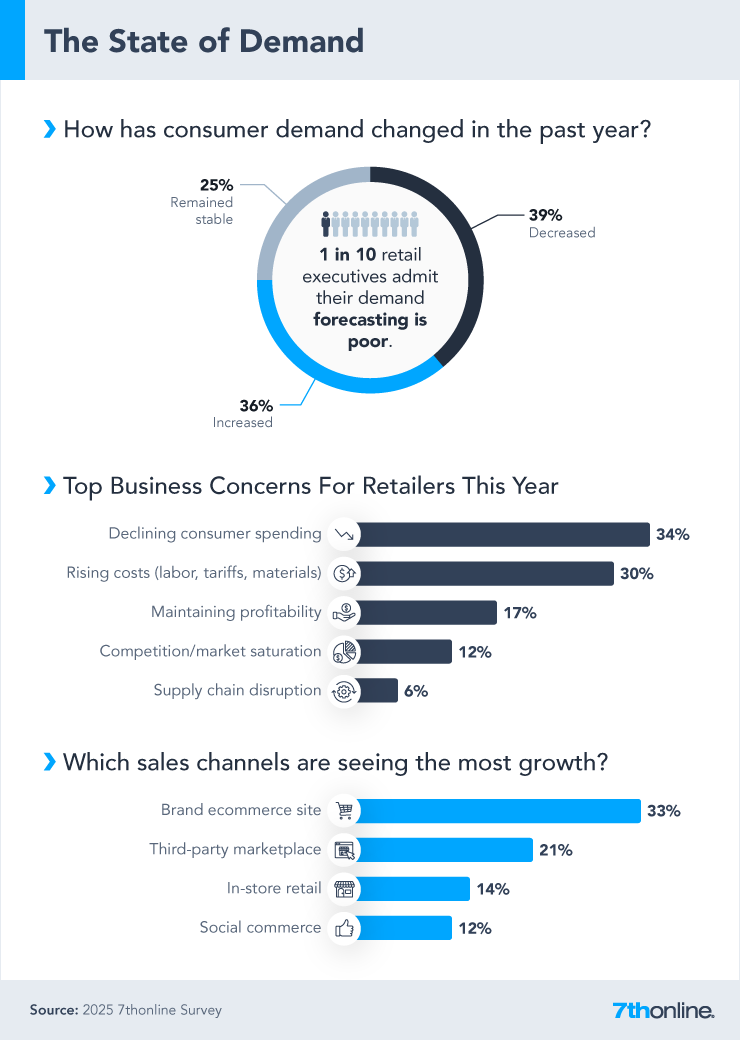
As consumer demand shifts, retailers are seeing the strongest growth through branded ecommerce channels, with 33% reporting increased activity on their own sites. This suggests that more consumers are seeking direct-to-brand experiences, while traditional in-store retail and social commerce are capturing a smaller share of emerging demand.

Retailers Are Reinforcing Supply Chains—But Confidence Remains Mixed

More than 1 in 5 retail executives say they’re not confident in their supply chain’s ability to manage disruptions. To reduce risk, many are cutting inventory levels, diversifying suppliers and making infrastructure investments aimed at improving flexibility and resilience.
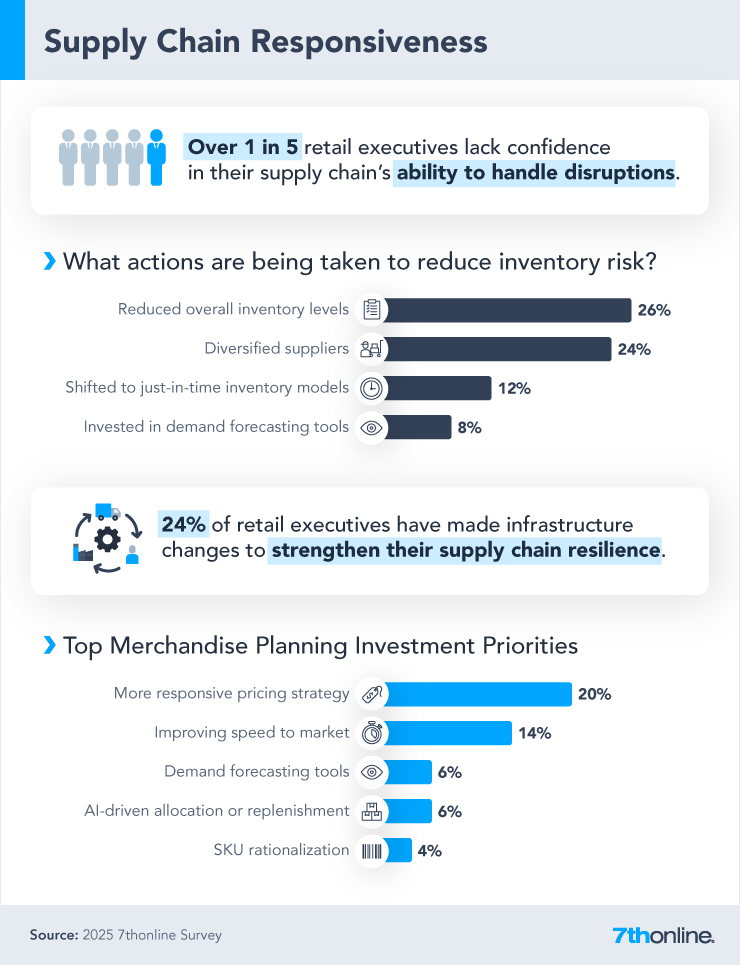
To reduce inventory risk, retailers are taking tactical steps like cutting inventory levels and diversifying suppliers—but their long-term focus is shifting toward smarter merchandise planning. More responsive pricing strategies (20%) and speed to market (14%) top the list of investment priorities, reflecting a push to become more agile amid ongoing supply chain uncertainty.

Tariff Pressures Are Forcing Retailers to Rethink

With 73% of retail executives expressing concern about rising tariffs over the next year, many are already weighing how to manage increased costs. From passing costs onto consumers to renegotiating supplier terms, retailers are navigating complex decisions in an uncertain economic environment.
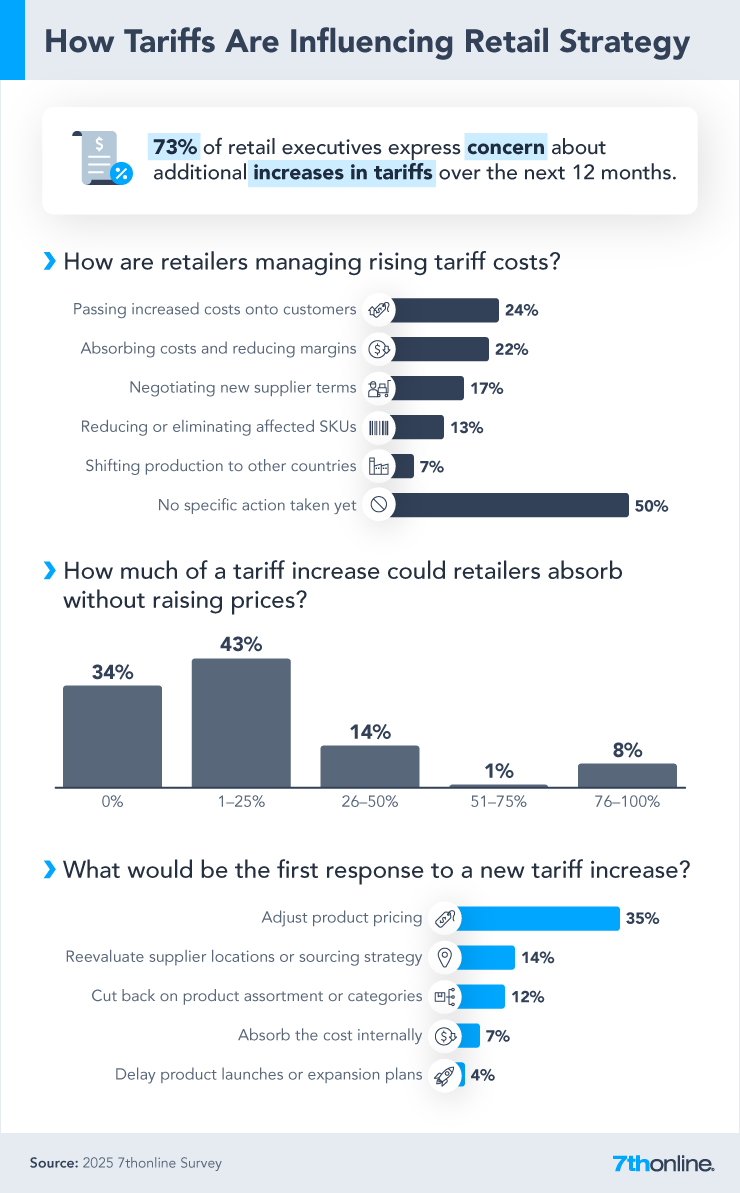
Half of retail executives have yet to take specific action in response to rising tariff costs, but among those who have, the most common strategies include passing costs to customers (24%) and absorbing them internally (22%). Most retailers say they could only absorb a 25% tariff increase or less before needing to raise prices, and 35% say their first response to a new increase would be to adjust product pricing—highlighting how limited their flexibility truly is.

Retailers Are Cautiously Exploring AI—But Barriers Remain

A third of retail executives are already using AI to forecast demand, and 34% expect it to play a major role in sustaining or growing profits within the next two years. While most are maintaining their current tech investments, adoption is still limited by internal expertise gaps, budget constraints and uncertainty about ROI.
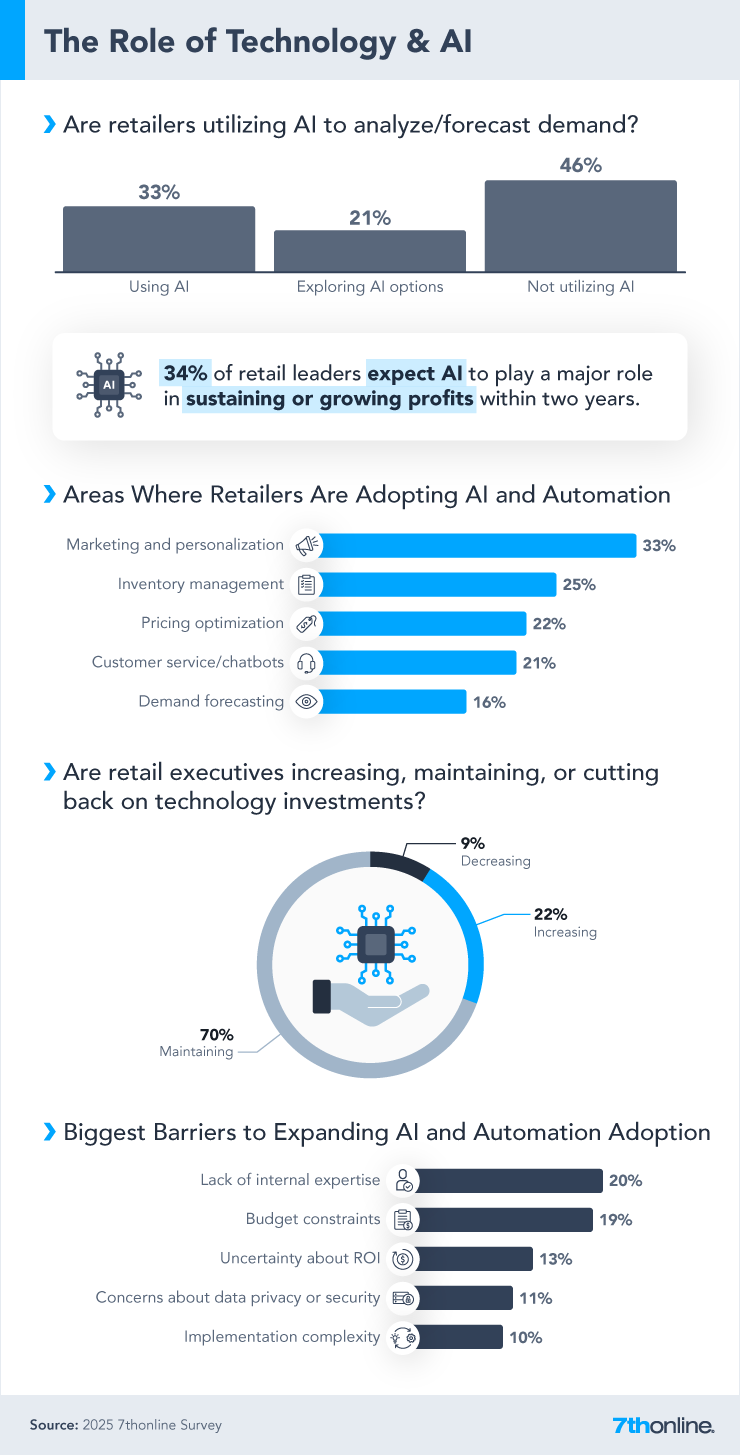
Retailers are exploring a range of AI applications, with marketing, inventory management and pricing optimization leading the way. Only 16% are currently using AI for demand forecasting—despite growing recognition of its potential. 

What’s Ahead for Retail Strategy

Retailers are balancing immediate pressures with long-term priorities—from managing tariff impacts to cautiously adopting innovative technology such as AI. As 2025 unfolds, building flexibility, improving forecasting and investing in strategic planning will be key to staying competitive.

Methodology

7thonline surveyed 105 retail executives about their retail strategy from June 2-11, 2025. Of the respondents that disclosed their job title, 53% were C-suite executives, 16% were owners and 8% were directors. 

7thonline is a leading AI-powered retail planning and forecasting software, enabling more effective planning, demand forecasting and inventory optimization for leading retailers and wholesalers. With embedded business intelligence and rich analytics, the solution offers complete demand visibility and planning capabilities at the most granular level. To learn more about our suite of solutions, book a demo or email us at info@7thonline.com

Why AI Data-Driven Retail is the Future—and How to Get There

Merchandise assortment planning has undergone a major transformation over the past few decades—from manual processes and spreadsheets like Excel to various planning systems. Tech advancements in retail added some structure but many still relied on guesswork, labor-intensive processes and siloed data.

As the retail landscape became more complex (such as with the rise of omnichannel) and consumer expectations rose, the need for sophisticated tech solutions became even more pronounced. That growing complexity paved the way for artificial intelligence to transform how retail brands think about their merchandising strategy.

business meeting over graphs on a computer

Why Retailers Still Struggle: Common Pain Points

Despite advances in technology, many retailers continue to face stubborn pain points leading to off-the-mark inventory decisions. Data is often fragmented and scattered across teams and systems, resulting in information overload without actionable insight. Adding to the challenge: the expansion of omnichannel operations, global supply chain disruptions, tariffs, market saturation, waning brand loyalty and more. The stakes are too high for patchy assortment strategies. 

In 2023, the fashion industry produced between 2.5 and 5 billion units of excess stock. That’s up to $140 billion in lost sales, according to Business of Fashion. Meanwhile, consumers are frustrated—brands are losing out on an average of 20 percent in monthly profit due to out-of-stock sizing, a shopper’s biggest complaint.

The AI Advantage: Balancing Art and Science

Retailers are increasingly turning to data-driven tools to overcome these challenges—and strike the right balance between demand, availability and profitability with AI-powered tools. A recent study found that 75 percent of fashion executives plan to adopt advanced analytics and AI to automate key processes, from forecasting to inventory allocation, in 2025. These proactive strategies are already delivering results for forward-thinking brands; they reported AI has improved stockouts by as much as 25 percent. AI enhances the art of merchandising and strengthens it through powerful data-backed insights. Creativity and brand identity still matter, but now they’re supported by real-time, data-informed decision-making.

Data-Driven Retail Decisions and AI-Powered Merchandising

AI enables a more agile, responsive approach to inventory planning. It processes vast datasets in real time, revealing insights that manual processes would miss or take weeks to uncover. Forecasting becomes more precise by analyzing historical trends at a granular level. Risk is reduced as production decisions are informed by what actually sells, cutting down on waste and markdowns. And with full visibility across channels, teams can better align around performance metrics for DTC, wholesale and ecommerce. A single source of truth empowers smarter collaboration across departments from design and production to planning and finance. 

As manual errors decline and efficiency improves with smarter planning, customer satisfaction rises. Meeting demand with the right products in the right sizes at the right locations ultimately drives profitability and strengthens brand performance.

Steps to Perfecting Merchandise Assortment with AI

Perfecting merchandise assortment with AI begins with smarter planning. Retailers must analyze past sales and behavioral data to uncover not just what sold, but why. AI uncovers deeper insights, including customer affinities and regional preferences, to guide more targeted assortment decisions.

Next, teams must align around common inventory goals, lead times and budget constraints. When all departments operate from the same playbook, planning becomes proactive rather than reactive.

Then, it’s all about placement, which products to put where, when. AI enables retailers to determine the most optimal localized assortment mix, determined by each SKU’s propensity to sell at each location, based on demand drivers like weather patterns. By combining push strategies, using preset rules like store size and sales volume, with pull strategies driven by real-time demand, retailers ensure each store has the essential stock.

Once inventory runs out, it’s time to replenish. AI also enhances replenishment strategies; when items sell, inventory can be shifted from other locations or reordered as needed. This adaptability reduces the risk of overproduction and keeps shelves stocked.

Continuous Optimization: Analyze, Forecast, Repeat

Assortment planning doesn’t end once the product lands in shoppers’ hands. AI thrives on continuous data feedback, improving forecasting models with every cycle. Over time, planning becomes more accurate, responsive and aligned with customer demand.

Perfecting your merchandise assortment with AI isn’t about removing human insight—it’s about unlocking its full potential. By turning complex data into clear direction, AI helps retailers thrive in a world where speed, precision and personalization are no longer optional—they’re essential.

Read the full article here: https://issuu.com/mannpublicationsmagazines/docs/fm_june_july_full?fr=sNzA3ZTg2MDI5NTU

7thonline is a leading AI-powered retail planning and forecasting software, enabling more effective planning, demand forecasting and inventory optimization for leading retailers. With embedded business intelligence and rich analytics, the solution offers complete demand visibility and planning capabilities at the most granular level. To learn more about our suite of solutions, book a demo or email us at info@7thonline.com.


Retail and Manufacturing Operations: The Possibility of Reshoring with AI & Automation

The conversation around bringing fashion and apparel manufacturing back to the United States has grown louder in recent months as tariff news continues to hit the stands—especially as 97% of goods in the industry are imported. For many, the idea seems aspirational; limited by high labor costs, outdated infrastructure and a lack of technical workforce, the barriers appear to be high. But we’re at a critical inflection point. Automation and artificial intelligence (AI) have matured to the point where reshoring is not only possible—it is practical given the right circumstances.

Our CEO, Max Ma, shared his opinion on reshoring for fashion and apparel with Sourcing Journal: https://sourcingjournal.com/topics/technology/reshoring-immigration-technology-manufacturing-trump-made-in-america-1234749503/

There was a time when regions across the country were thriving apparel production hubs. Factories operated efficiently, often powered by skilled immigrant labor and close ties to local retailers. That ecosystem didn’t vanish because it was inherently flawed, it shifted overseas due to cost advantages. Today, however, the dynamics have changed. Labor costs in countries like China have risen significantly, while regulatory burdens and global instability have introduced new risks into extended supply chains.

Meanwhile, pockets of domestic production still exist. Lower-cost regions such as South Carolina maintain infrastructure and history in apparel manufacturing, and niche factories continue to operate in urban centers like Brooklyn, New York. The conditions for regrowth are in place. What is needed is an alignment in policy, technology and the industry’s commitment.

The Role of AI in a Reshoring Revolution

Automation and AI are the great equalizers in the reshoring conversation. Dark factories have been seen in other industries—so it’s not unfounded that they could be possible for fashion as well but it’s unlikely apparel manufacturing will be entirely human-free; significant portions of the production process from fabric cutting, dyeing, material transport and even quality control, can be automated today. These advancements dramatically reduce dependency on manual labor while increasing output consistency.

Beyond the factory floor, AI-driven platforms like 7thonline are already transforming how retailers plan and manage inventory. By automatically generating merchandise plans based on historical data and predictive analytics, retailers can reduce overproduction, avoid lost sales and respond more quickly to changing demand. These benefits are particularly compelling when paired with shorter, domestic supply chains.

When production happens thousands of miles away, a single purchase decision can take months to reach the sales floor. The risk of misalignment is high. Reshoring, supported by intelligent planning systems, drastically reduces that lag and associated costs.

Policy Must Match Industry Momentum

For this reshoring vision to become a reality at scale, government support is essential. Other countries that have successfully built automated manufacturing sectors, such as Japan, South Korea and China, have done so with significant public investment. These governments have subsidized robotics, funded workforce training and created tax incentives to attract industrial development.

The United States should review success stories and take inspiration while following suit. Subsidies for automation equipment, tax incentives for reshoring investments and grants for workforce development would create a more level playing field. These policies should be considered industrial aid because they are strategic investments that can lead to job creation, higher tax revenue and greater national resilience.

Looking Ahead: A Smarter Supply Chain

The time to act is sooner rather than later. The fashion and retail industries are under immense pressure to improve speed to market, reduce waste and operate more sustainably. Especially as tariff uncertainty continues to hit the newsstands. A smarter, more localized supply chain that’s enabled by automation and powered by AI is the solution.

As we look to the future, the question is no longer whether reshoring is possible. The question is: are we ready to do the work collectively, across sectors and with government support to make it happen? With the right combination of policy, technology and willpower, we can build a new era of American manufacturing. One that is more intelligent, responsive and resilient than ever before.

7thonline is a global leader in AI-native demand planning and inventory management solutions, offering retailers and wholesalers innovative functionality that optimizes their supply chains and drives profitability across all key channels. To learn more about our merchandise software solution, contact the team at info@7thonline.com or book a demo.

Reinventing Retail Tech—How 7thonline is Optimizing Merchandising with AI

7thonline Founder and CEO, Max Ma sits down with The PowerTalk Show and Navin Shetty to talk about transforming how global brands manage inventory, forecast demand and drive profitability.

“Retailers are still stuck on Excel. And Excel is the source of most inventory problems.” – Max Ma

While working in IT at a retail company, Max noticed systemic inefficiencies—millions in unproductive inventory, siloed decision-making and a heavy reliance on Excel. This sparked the idea for a smarter solution. Fast forward 26 years, and 7thonline is now trusted by brands like Calvin Klein, Tommy Hilfiger, Canada Goose and more.

The Problem: Excel is Still in Charge

Despite massive advancements in retail technology, Max highlights a reality few discuss: 70-80% of retailers still rely on Excel to make million-dollar inventory decisions. “It creates silos, errors, and a total lack of control,” Max says. “Our goal was to replace Excel—without intimidating the user.”

7thonline mimics the Excel interface while running a powerful AI-driven engine beneath the surface. The result? Fast adoption, deeper data insights and smarter forecasting.

The Solution: Smarter Planning Through AI-Based Retail Tech

Max and his team began integrating AI into their system over 20 years ago—long before AI became a buzzword.

“AI isn’t new. Our team has worked with it for 30 years. The difference now is people are finally paying attention.” – Max Ma

One standout feature? Test Buy Forecasting, which helps brands identify top-selling products within the first two weeks of launch. That agility alone has helped clients:

  • Increase gross margins by 30-35%
  • Reduce pre-season buys by half
  • Allocate budgets dynamically based on real-time demand

Real Results: Case Studies That Matter

7thonline isn’t just theory—it’s delivering real-world results. One client saved $1 per garment by placing production just one week earlier. With millions of units sold annually, that adds up fast.

In another case, a brand used 7thonline’s AI forecasting for a single product category of 30 styles. In just four weeks, they generated $320,000 in additional sales—a number that speaks louder than any sales pitch.

The Future: AI-Powered Trend Mining

The next big thing? Max is excited about new LLM (large language model) features that act like an intelligent co-planner for merchandisers. The platform will soon be able to:

  • Analyze macro trends from the internet and social media
  • Identify new product opportunities
  • Suggest seasonal forecasting based on current market shifts

AI will not replace people—but it will amplify their decisions. That’s where the future lies. Watch now to hear how Max Ma and 7thonline are not just forecasting demand—but creating it: https://www.youtube.com/watch?v=bEGnLYQSLbY 

7thonline is replacing Excel and saving retailers millions. To learn more about 7thonline’s platform, book a demo or email us at info@7thonline.com.

Why AI Is Turning Order Fill Rate Into the Most Important KPI for Fashion Wholesalers

In the complex world of supply chains, there’s a metric quietly shaping wholesale success. The fashion industry uses countless KPIs to assess performance: profit margins, cash flow ratios, cost of goods sold and more. But there’s one crucial KPI that’s often overlooked and is quickly becoming one of the most important in a loyalty-focused retail landscape: order fill rate.

Let’s start with the basics. 

Order fill rate isn’t just a measure of operational efficiency. It’s the metric that ultimately determines trust and revenue. It’s a powerful indicator of how well your business understands demand, manages inventory and serves retailers, distributors, franchisees, etc.. But the truth is, a lot of wholesalers don’t even really track order fill rate, let alone harness the power of AI to help solve the problems related to it. 

So, what exactly is the order fill rate?

The order fill rate simply refers to the percentage of retail orders that can be immediately and completely fulfilled using stock that is available to ship; from warehouse to store, it’s the ability to satisfy store distribution orders without delay and in its entirety. A high fill rate means lower lost sales and happy retailers whose orders ship quickly. A low fill rate means stockouts, shipping delays and shaky client relationships. These are problems no brand can afford in today’s competitive market.

This is where AI comes in. AI is revolutionizing how fashion brands manage multi-channel inventory, predict demand and maximize fulfillment without wasting resources.

Improving Order Fill Rates: The New KPI for B2B Wholesale Success

In B2B wholesale, improving your order fill rate is one of the most important measures of success. Why? Because loyalty today is built on reliability. If your business sells to department stores, independent retailers, franchises and ecommerce sites, every order matters as every sales channel matters. When a buyer places an order, whether it’s a big box retailer or a franchisee in another region, you need to ask “Are you able to deliver on time and in full?”

If the answer is no, that lost sale is just the beginning. Unfulfilled orders because of inadequate inventory levels, leads to clients fighting for the same inventory, damaging relationships and margins. Clients notice when their orders get delayed, short-shipped or canceled, and it impacts their trust. Building a strong rapport not only encourages repeat business but could also mean more shelf space for your products—winning higher priority as they expand multi-brand partnerships.  

The reality is simple: clients are happy when you don’t take their inventory away from them. Improving fill rates means efficient multi-channel management—having enough of the right inventory available, keeping every channel and every customer satisfied.

How AI Fits Into Market Week—and Why It Matters More Than Ever

Market Week is one of the most exciting times in the fashion industry, when buyers and wholesalers come together to network and negotiate, preview and place orders for the upcoming season. While exciting, this period is paramount and highly stressful—this series of events set the stage for fashion. Buyers need to plan as accurately and quickly as possible to place orders that account for potential demand in the next six months or so. Brands need to continuously run available-to-sell (ATS) reports and ensure buyers get the products they need.

For wholesalers, this is a high-stakes moment. They commit to producing garments in bulk based on projected orders, carrying the significant financial risk of manufacturing inventory upfront; accuracy is critical for cut-to-forecast processes. Underproducing leads to lower fill rates and lost sales. Overproducing leads to capital tied up in excess inventory and a hidden opportunity cost from products that might’ve been sold but weren’t produced due to budgets.

This is where AI is making a difference. By analyzing past sales patterns, real-time demand signals and cross-channel behavior, AI tools can help brands make smarter production decisions. Instead of relying solely on Excel or limited buyer feedback, brands can better track inventory, forecast with greater accuracy, make dynamic decisions and protect their bottom line.

AI Moves Beyond Forecasting: Smarter Distribution in Real Time

In wholesale, order fill rate measures how effectively a business fulfills client orders against the total demand it receives. A high fill rate reflects a strong ability to meet customer needs and protect retail relationships. While every business would love to hit a perfect 100%, in practice, healthy fill rates typically range between 90% and 95%, with top-performing companies reaching 97% to 99%; 1% of improvement results in millions in additional profit.

Success in wholesale fashion doesn’t have to be reserved for a select few. AI is helping level the playing field, giving even medium sized brands the tools to compete smarter, not just harder.

AI helps businesses move beyond rough forecasting and into real-time planning. Instead of guessing, AI models can continuously monitor order patterns, regional demand shifts and channel performance. Ultimately, AI empowers brands with actionable, real-time inventory optimization, giving them the power to serve every client better, protect their margins and grow more sustainably.

Integrated AI: The Key to Smarter, Seamless Wholesale Operations

Choosing the right AI solution is just as important as using AI in the first place. Efficient multi-channel management requires AI tools that address the needs of each wholesale route as sales channels have their own unique challenges. To see real results, brands need a fully integrated AI system, not just an add-on module. 

An integrated solution doesn’t rely on a team of analysts to interpret data and make manual adjustments. It continuously analyzes, predicts and optimizes behind the scenes, allowing staff to simply adjust and act on clear insights. By contrast, retrofitting AI into an outdated system usually leads to limited improvements and missed opportunities. A true AI-driven platform is built from the ground up, and fine-tunes over time by incorporating industry best practices, designed to connect seamlessly across wholesale operations from planning to forecasting to inventory management, so that every decision is faster, smarter and more aligned with client demand.

At the end of the day, the brands who succeed will be the ones who can deliver what retailers want, when they want it, without compromising relationships or profitability. Managing inventory well has always been a critical part of the business, but today’s market demands a smarter, faster, more precise approach. Order fill rate is a clear reflection of your ability to meet demand and build loyalty across every channel you serve. With the AI right tools in place, wholesale brands can go from surviving to thriving in an increasingly competitive industry.

Read the original article in the AI Journal here.

To learn more about how your team can improve order fill rates, email us at info@7thonline.com or book a demo with our team.

5 Strategies Retailers (and Wholesalers) Can Use to Offset Tariffs

As global trade dynamics continue to shift, retailers and wholesalers are finding themselves in a new era of volatility. Once beneficiaries of globalization, the consumer goods sector is now facing increased uncertainty as protectionist policies and tariff expansions raise the stakes across supply chains. 

According to a recent PwC report, these tariffs could impact the consumer product sector by up to $134 billion. That’s five times the current tariff load of $27 billion. And the apparel industry is bearing the brunt of it. To remain competitive and profitable, businesses must embrace a more precise, tech-enabled and forward-thinking approach.

5 Tariff Strategies to Avoid the Cost of Getting it Wrong

One of the most underestimated consequences of tariffs is the cost of getting it wrong. Overbuying, inaccurate forecasting, or delayed inventory movement now come with a heavier price tag. Goods that were once slightly overstocked and marked down for clearance are now inventory liabilities that were more expensive to import in the first place.

As Arielle Knutson, CEO of athleticwear brand Oiselle, said to a Reuters reporter, “Ordering the right amount of product—and not being stuck with too much cash tied up in inventory—is key. It’s an almost impossible needle to thread.”

It might feel impossible, but it isn’t. Here are five tariff strategies wholesalers and retailers can take to offset the impact of tariffs:

1. Ditch “Excel Hell” for a Dynamic AI Platform

Managing critical functions through disconnected spreadsheets is no longer sustainable. Excel may have once worked for forecasting and inventory planning, but it can’t keep up with the pace, complexity and volatility created by shifting tariff policies and global supply chain disruptions. Relying on siloed data leads to misalignment across teams, delayed decisions and costly mistakes. If merchandising, planning and supply chain teams are all working from different files or outdated reports, it’s nearly impossible to respond in time to tariff-driven cost increases or sudden inventory shifts. Integrated, AI-powered platforms replace “Excel hell” with a centralized system of truth—eliminating manual processes and enabling faster, smarter decision-making.

These tools analyze real-time data across departments including merchandising, demand planning, sourcing and logistics, to generate predictive insights that help retailers buy smarter, reduce overstock and respond swiftly to market changes.

2. Nail Down Forecasting Accuracy

Historically, imprecise forecasting has plagued the industry, leading to overstocking, stockouts and wasted resources that impact profitability. With tariffs, the cost of being inaccurate is magnified. To succeed, retailers must embrace planning tools that offer better insight into what sells, where and when. Advanced inventory planning systems, powered by AI, allow retailers to align supply with demand precisely. By analyzing sales data and market trends in real time, AI-driven systems can accurately forecast demand and ensure inventory is purchased with purpose. 

3. Start Earlier

Timing is everything. Beginning the product lifecycle earlier gives businesses more room to negotiate with suppliers and avoid price shocks. One 7thonline client saved an average of $1 per garment simply by starting the production planning process one week earlier than competitors.

Early actions also allow businesses to diversify sourcing, reroute logistics and hedge risk before it becomes a crisis. If one supplier faces an increase in tariffs, retailers have more time to react; they can negotiate, find cost savings elsewhere or go with an alternative supplier.

4. Don’t Let Excess Inventory Drain Your Margins

Tariff-inflated products that don’t move fast enough get marked down, wiping out margins even further. Excess inventory takes up space, ties up capital, increases carrying costs and in a tariff-laden landscape, represents money spent on goods that may never sell at full price.  The key to reversing this trend is smarter buying from the start, backed by real-time visibility into demand signals. With integrated inventory management platforms, retailers can continuously monitor sales data and adjust open-to-buy budgets accordingly. 

5. Give People What they Want

Rather than planning for supply, retailers need to plan for demand. That starts with better buying strategies that prioritize precise assortment planning and allocation; the ability to identify the right products and match them to the right store locations, in the right sizes, is critical for the consumer experience. Inventory management solutions ensure retailers are stocked with high-demand products and can adapt to shifting consumer behavior. AI provides smarter allocation recommendations based on the propensity to sell for each product at each store location. 

Read the original article on Fashion Mannuscript here.

To learn more about how your team can use AI to offset increased tariff costs, email us at info@7thonline.com or book a demo with our team.

Reducing Retail Tech Debt: Why AI Stack Selection Matters

Retail is in its AI era. From streamlining operations and optimizing supply chains to increasing personalization for shoppers, retailers have been eagerly jumping on the artificial intelligence bandwagon to modernize their brand and workflows. As the industry continues to embrace digital transformation and adopt innovative AI solutions, it’s important to remember—fragmented systems and duplicative functionality contribute to increased tech debt. 

person looking at a report on tablet to analyze store measurement

Be wary of bolting new AI tools onto already complex tech stacks as it could create a sprawling mess of disconnected platforms and overlapping capabilities; simplify your AI stack before it becomes tech debt. Managing technical debt is crucial for maintaining agility and delivering exceptional customer experiences. Technical debt refers to the long-term costs associated with choosing suboptimal solutions that require future rework such as additional implementations. Accumulating technical debt can hinder innovation and agility, making it challenging for retailers to adapt to market changes effectively. 

Duds & Dupes: Your AI Tech Stack

Many retailers are expanding their technology stacks with a variety of AI platforms to support current and future business needs. As businesses grow, and needs change, retailers will seek out more solutions that address new concerns; however, sometimes this leads to patchy workflows and/or duplicative functionality. Streamline your technology stack by adopting a single AI system that aligns with your business needs and scales as you grow—analytics, personalization, forecasting, inventory optimization and more—not only simplifying your AI stack but also enhancing operational efficiency.

In order for AI to be truly impactful, it must be embedded into every step of your workflow. Instead of piecing together a patchwork of specialized AI tools, or worse—fake AI modules, select a system that offers comprehensive functionalities to avoid the pitfalls of managing multiple disparate tools: outdated data, low visibility, inaccurate forecasting, limited collaboration, etc.. 

Eliminating redundant components and embracing multi-purpose services also simplifies your AI stack. You don’t need separate assortment management systems for ecommerce and physical retail, or isolated demand planning for stores and wholesale accounts. Simplification not only cuts down on the resources needed for system upkeep but also accelerates the implementation of new features, ultimately enhancing your ability to respond to market demands and meet shopper expectations. As retailers continue to embrace digital transformation, choosing an all-in-one AI system can be the smartest way to stay ahead—without drowning in complexity.

The takeaway: you don’t need more AI tools. You need a better, unified one.

While adopting AI is essential for staying competitive, retailers must approach its integration thoughtfully—choose integrated and comprehensive solutions that closely align with business needs from the start. Unified AI platforms reduce complexity and technical debt, paving the way for sustained innovation and ensuring that your systems grow in tandem with your business objectives.

7thonline is a leading provider of cross-channel merchandise planning and assortment management solutions, empowering retailers and wholesalers to make smart decisions at every step of the retail workflow. With artificial intelligence and machine learning embedded into the core of the platform, 7thonline has been enabling leading retailers and wholesalers to optimize planning processes, demand forecasting and inventory productivity. To learn more, email us at info@7thonline.com or book a demo with our team.

AI-Powered Assortment Planning & Size Profiling for the Ozempic Generation

Accurate sizing and assortment planning are critical to both customer satisfaction and overall profitability, especially for retailers in apparel and footwear. When sizing misses the mark, it leads to excess inventory, higher return rates and lost sales. And as weight-loss drugs continue to gain popularity, size profiling has to become more dynamic to keep up with shifting trends. By harnessing data on shopper behavior, regional fit trends and inventory performance, AI-powered tools enable smarter, more localized assortment planning that boost sell-through, reduce returns and meet customers where they are—ensuring the right products, in the right sizes, reach the right customers at the right time.

Rise of GLP-1 & The Impact on Assortment Planning

Style, color, size. 

Assortment planners typically determine their mix 6-9 months in advance. And with lead times in production and planning, there’s little room for error—products made months in advance that don’t align with actual demand can tie up resources and margin for an entire season.

The rise of weight-loss medications is forcing retailers and wholesalers to be more agile and adjust their assortment planning to match the shift in size trends. While the long-term effect of weight-loss medications are yet to be seen, the apparel industry is already having to adapt their size curves as popularity for drugs like Ozempic and Wegovy soars. With 6% of the American population using GLP-1 drugs to lose weight, brands are starting to see smaller sizes selling more.

“Brands typically adjust (size) algorithms once a year. But now as more people use GLP-1 drugs, brands are updating these models more often than they have before to meet the need for small sizes.” – Kelly Pedersen, PwC retail leader.

Retailers who specialize in clothing or footwear know that accurate sizing is critical to customer satisfaction and profitability. AI can help improve size profiles by analyzing customer purchase patterns, returns data and even social media feedback in real-time to identify the most accurate sizing for different customer segments and simplify assortment planning. 

Enhancing Size Curves and Profiling with AI

AI enhances assortment planning by analyzing sales at the most granular level: style, color, size, by store, by week to recommend optimal buy. Instead of traditional, static clustering, AI systems such as 7thonline can optimize size profiling by store location to ensure demand is met. When AI fine-tunes sizing strategies, retailers benefit from higher profit margins as they avoid overstocking unpopular sizes while ensuring they have enough of the right sizes. 

Proactively react to shifting consumer behavior and needs with data-driven AI-based insights. By leveraging AI to its full potential, retail businesses can unlock efficiencies, reduce waste and meet consumer demand in a more personalized and profitable way. The future of retail is demand-based and data-driven—and those who embrace AI as an integral part of their operations will be the ones to reap the rewards in the rapidly evolving retail landscape.

7thonline is a leading provider of cross-channel assortment management solutions, including demand forecasting and inventory optimization for leading retailers and wholesalers, offering complete demand visibility and planning capabilities for wholesale, retail and ecommerce

To learn more about how AI can help make assortment planning more agile and dynamic, book a demo or email us at info@7thonline.com

Retail Planning Software: Optimize Assortment Planning and Demand-Driven Inventory With AI

The data is in: demand is high but sentiment is not. Up 1.4%, consumer spending was stronger than expected in March, reported the Commerce Department. However, consumer confidence is still slipping, especially with uncertainty around the tariffs. In a world where retail sales data is revealing mixed signals, strategic inventory assortment planning is paramount. 

Planning for Inventory Productivity and Sell-Through Rates

Retail assortment planning is a key part of merchandising strategy to determine the optimal mix of products to offer, in what quantities, when and where—to maximize sales and customer satisfaction. With a weak sentiment index, assortment planning is critical to ensure each SKU earns its place on the shelf. 

Inventory productivity drives profitability in retail

As shoppers become more selective with their spending, retailers must curate more targeted assortments that align with shifting consumer priorities, minimize excess inventory and maximize sell-through. 

Utilizing AI-powered planning solutions, retailers are able to use real-time sales data and historical trends to forecast demand, ensuring that stores are neither overstocked nor understocked, and enhance sell-through rates. With more accurate demand forecasting, inventory levels are more closely aligned with actual sales trends, reducing the likelihood of markdowns and unsold goods that eat into profit margins.

Retail Planning for Demand: Software, Techniques and Models

A demand-focused, data-driven approach allows businesses to stay agile, plan with precision and protect margins. A delicate balance between art and science, assortment planning not only anticipates trendy and relevant products but also relies on data to analyze and forecast demand. Through demand planning software, powered by AI, retail is able to do this seamlessly—leveraging analytics for precision while relying on merchant intuition and creativity to connect with shoppers and give them what they want. 

Instead of a traditional, static clustering (or “the wedge”) approach, demand planning software helps maximize selling potential with granular insights that help retailers curate a localized mix. 7thonline’s demand planning technique goes as far as the style, color, size, by store, by week—localizing assortments based on the store’s propensity to sell based on product attribute performance. The system will recommend buy based on demand targets and even use proprietary demand planning models to anticipate sales for new and seasonal products

7thonline is a leading provider of cross-channel assortment planning and management solutions, enabling more effective planning, demand forecasting and inventory optimization for leading retailers and wholesalers. With embedded business intelligence and rich analytics, the company’s solutions offer complete demand visibility and planning capabilities for wholesale, retail and ecommerce

To learn more about how AI can help brands and retailers drive revenue amid weak consumer sentiment through smarter assortment planning, book a demo or email us at info@7thonline.com

The Role of AI in Allocation: Right Product, Right Place, Right Time

For retailers that want to get ahead of their competitors, artificial intelligence will play a critical role going forward. Retailers globally lost an astonishing $1.77 trillion in 2023 due to poor inventory management according to IHL. However, AI stands ready to change that—if implemented correctly.

AI is already playing a major role in the retail industry, and its role will only increase over time. In a report entitled “Market Guide for Retail Assortment Management Applications: Short Life Cycle Products,” Gartner predicted that the top 10 retailers globally will tap into AI “to facilitate prescriptive product recommendations, transactions and forward deployment of inventory” by the end of 2025.

Smart allocation will be one area of particular importance for retailers, as getting the right products to the right place at the right time is critical for reducing or eliminating stockouts and price cuts caused by bloated inventory at a particular location.

How AI optimizes product allocation

Traditionally, product allocation is supply-driven; products are allocated based on static, predetermined rules set by internal teams: square footage of stores, sales volume, week of supply, etc. With artificial intelligence, allocation becomes dynamic. 

AI can drill down deep into the data to analyze and generate recommendations for site-specific assortments. Driven by demand drivers such as propensity to sell, AI systems can determine the best style and size mix within each category for each location and channel, and determine a sales index for individual products by analyzing historical sales data. 

To optimize product allocation, AI looks at the retailer’s sales history, including inventory levels and stockouts, to determine where that previous allocation strategy went wrong and then correct it. Effective allocation requires analysis of multiple data sets from each location, and only AI is capable of providing accurate analysis of all these data sets simultaneously.

In short, here’s how AI does all of this. The technology classifies and categorizes information based on visual, numerical or textual data. It then analyzes and modifies the retailer’s strategies, plans and allocations based on real-time data. It automatically generates analysis that makes faster response times possible and can help retailers retrieve relevant information quickly.

Real-time decision making

The advent of AI is empowering smart, real-time decision making across channels and locations. Before AI, retailers relied on spreadsheets and manual allocation methods that were time-consuming and error-prone—this is still common today.

Introducing AI into retail workflows transforms the planning process, making it effective and dynamic. With AI, retailers are armed with real-time analysis and smart recommendations that improve regional and store-level distributions; the industry-specific algorithms continually monitor real-time sales data to provide the most optimal recommendations.

Through this continuous improvement, AI can identify opportunity gaps in product ranges at each location, leading to additional sales—if those gaps can be filled. Without real-time understanding of inventory levels, retailers can refill stock right when it’s needed at the locations that require it.

Adapting to current conditions

Retailers face potential problems at both ends of the sales spectrum. On one side, they must deal with shifting consumer behaviors, but at the other end, they face the potential for supply chain disruptions that could prevent them from addressing those shifting behaviors.

However, AI is capable of continual monitoring and measuring actual performance against the plans created, creating a dynamic feedback loop. This feedback loop enables retailers to map their supply chains and connect parts of their business that were previously disconnected.

McKinsey estimates that retailers which implement technology to capture the variability of demand via forecasting can better predict customer behaviors, resulting in an average of a 3% to 4% increase in revenue. Through machine learning, as more data is collected and analyzed, these plans will become more and more accurate.

How to use AI to make predictions

According to McKinsey, autonomous supply chain planning can boost revenue by 4%, slash inventory by 20% and cut supply chain costs by 10%; AI enables retailers to continue meeting customer demand while reducing inventory (and its associated costs) because they can accurately predict demand across sizes, colors, locations and more.

McKinsey has found that companies have more success with implementing the technology when supported by four essential elements.

The first involves rewiring the organization by deploying real-time allocation dashboards, setting up a cross-functional supply chain organization and increasing the speed of critical decision making.

Secondly, McKinsey advises retailers to streamline their processes by enabling segmented business processes, promoting closed-loop planning and supporting “what-if” predictive scenario planning for allocation. Additionally, retailers should establish standard operating procedures to manage exceptions to typical situations.

Thirdly, McKinsey recommends digitizing the supply chain by leveraging scalable technologies and tools. Retailers are also advised to enable advanced analytics and AI-based planning solutions, integrate their technology across their supply chain and scale their technology to multiple regions and business units.

Finally, retailers should foster an accountability mindset and empower employees to make decisions based on the data and analysis received. Implementing AI also requires building talent with deep machine-learning capabilities—or outsourcing it.

Correct implementation of AI

When implemented correctly, AI is game-changing for retailers, but the key here is “correctly.” To achieve real value from AI, retailers need to move beyond buzzwords and embed AI into every step of their daily processes—rather than amplifying individual modules that are segregated from the rest of the system. 

For example, as a retailer, you need your open-to-buy system to communicate with your demand-forecasting tool, but AIs that doesn’t tap into all data sets simultaneously can’t provide accurate analysis or helpful information. Real AI should be able to provide robust analysis of multiple datasets without a data scientist’s expertise. 

Read the original article on The AI Journal here.

To learn more about our AI-native inventory management and demand planning solutions for retailers and wholesalers, email us at info@7thonline.com or book a demo with our team.